14 Inspiring Free Verse Examples in Poetry for Creators
by WriteSeen
Free verse examples in poetry can help you break free from rules and find your own creative edge.
We’ve collected 14 poems that show how leading writers and innovators use form, sound, and imagery to shape meaning without traditional constraints.
Whether you want to build community, test new ideas, or sharpen your craft, these examples offer practical strategies and inspiration for creators focused on originality, collaboration, and professional growth.
1. Song of Myself by Walt Whitman
The strongest free verse examples in poetry often begin by redefining what a poem can be. Whitman’s “Song of Myself” is the starter pistol for free verse in English. It’s big, wild, and unafraid of sprawling lines or “imperfect” rhythm. This poem earned its place on every creative’s must-read list because it unlocks freedom and scale for your work.
Craft Breakdown
- Elevates ordinary life with catalogues and detail (“I loaf and invite my soul”), giving you permission to expand without losing meaning.
- Builds rhythm from thought and natural breath rather than meter, showing you how to root line breaks in authentic cadence.
- Treats the reader as collaborator, inviting direct connection and fueling peer-driven creativity.
Try This
- Draft a stanza cataloguing your day’s details. Let image order set the pace.
- Read aloud to find the music in your lines, then use that for natural enjambment.
- When you need to move from a private note to a public callout, apply Whitman’s direct address.
“Song of Myself” proves that a poem’s energy doesn’t come from rhyme; it comes from momentum, surprise, and honest breath.
Best for: Writers ready to go big, list boldly, and make their voice impossible to ignore. If you want expansion and clarity without ornament, this poem is your template.
2. Mother to Son by Langston Hughes
Langston Hughes gives you the skeleton key to accessible voice in “Mother to Son.” It’s tight, speaks like real talk, and spins hardship into forward motion.
Craft Breakdown
- Makes metaphor carry a life story (“Life for me ain’t been no crystal stair”) and turns rough details into resilience.
- Uses vernacular and repetition so the poem feels lived, not staged, helping you develop persona and motivational tone.
- Keeps the through-line crystal clear by holding one voice and core metaphor from start to finish.
Peek at this structure: If you’re aiming for relatable, short form poems with punch, follow how Hughes sustains one fresh image without letting it sag.
Try This
- Build your own 12-line riff on a challenge and sustain a central metaphor.
- Use parallel openings or refrain lines to create rhythm instead of rhyme.
Best if you’re building monologues or persona poems, especially when you want your work to motivate rather than just recite.
3. Fog by Carl Sandburg
Sandburg’s “Fog” is proof you don’t need many lines to make free verse stick. He shows you how minimalism can paint a whole scene, even with just a few words.
Craft Breakdown
- Transform a natural event (fog) into a vivid, animal-like moment. Use personification to make ideas tangible.
- Short, sharp lines give white space power. Every pause is deliberate, guiding your reader’s breath and focus.
- Compression of image packs a punch. There’s nowhere for filler to hide.
Try This
Take something simple (rain, wind, a dog’s bark), and write six single-image lines. Focus on sound and animal movement.
Fog demonstrates how the right metaphor compresses action and emotion into something you’ll remember after one read.
Great fit for those building micro-poems, storyboards, or want punchy copy with visual bite.
4. Autumn by T. E. Hulme
Hulme’s “Autumn” gives you the formula for imagist-style free verse, shrinking cosmic ideas into tiny, sharp lines.
Craft Breakdown
- Pick one object (moon, hedge), describe it with two crisp comparisons, then let the image do the talking.
- Minimize fuss. Every word on the page works.
- Show, don’t explain. Leave space for readers to supply the feelings.
Best for poets, lyricists, or anyone wanting clarity and edge. If you need proof that small poems can tackle big feelings, this is it.
5. The Red Wheelbarrow by William Carlos Williams
Williams’ “The Red Wheelbarrow” is a 16-word clinic in seeing and line breaks. He distills the whole world into a single object.
Craft Breakdown
- Uses split-word enjambment, forcing you to slow down.
- Sensory precision (red, white, glazed) gives the ordinary depth.
- Makes meaning through what’s shown, not told.
Try This
Find an overlooked tool in your creative space. Describe it in four sharp couplets.
This poem is a playbook for turning your attention into art. Big meaning built from seeing, not explaining.
Ideal for designers, photographers, and writers craving precise, image-first work.
At this point, you can see how varied free verse examples in poetry can be—from expansive catalogues to ultra-minimal imagery.
6. I Carry Your Heart with Me by E.E. Cummings
Cummings offers a love poem that works like a private message. It’s unrhymed, full of intimacy, and structured by emotion.
Craft Breakdown
- Punctuation and parentheses mimic hidden asides. Layer private notes inside public ones.
- Use recurrence and nested lines to build longing or gratitude.
- Play with syntax. Let emotion, not grammar, lead.
Try This
Draft a gratitude poem where parentheticals act as your inner voice.
Best if you want structural flexibility, emotional complexity, and a conversational love poem minus the clichés.
7. My Cat Jeoffry by Christopher Smart
Here’s a found treasure from the 18th century. “My Cat Jeoffry” is all repetition, devotion, and sharp observation.
Craft Breakdown
- Each line repeats an opening, forging rhythm from routine.
- Elevates small rituals (a cat’s antics) into worthy praise.
- Shows that list poems can ground even spiritual or playful work.
Try This
Write a one-page litany: use repetition to anchor the piece and detail to make it memorable. If you’re blending inventory, personality, and voice, start here.
When you want to honor ordinary life or turn routine into ritual, visit Jeoffry.
Perfect for creators focused on devotion, inventory, and finding wonder in the everyday.
8. From Blossoms by Li-Young Lee
“From Blossoms” transforms eating fruit into a celebration of community and joy. Lee’s free verse proves sensory experience can build structure.
Craft Breakdown
- Stacks taste, smell, and shared memory to create a narrative through feeling, not argument.
- Speaks in “we,” pulling readers into collective experience.
- Converts pleasure into a philosophy about savoring life.
Try This
Test drive this: Document a seasonal ritual (buying, eating, sharing) with three senses in twelve lines. End with a turn toward a life lesson.
Best when you want poems that gather people, offer pleasure, or turn everyday rituals into something wider and lasting.
9. Sloe Gin by Seamus Heaney
Heaney delivers sensory process in “Sloe Gin.” This is craftwork turned poetry. Each step is visible and tangible.
This is one of the most process-driven free verse examples in poetry, where sequence itself becomes structure and time replaces traditional meter.
Craft Breakdown
- Tracks making from foraging to bottling, teaching you to anchor poems in action and time.
- Uses seasonal cues (autumn, winter) as emotional weather.
- Jars, sugar, and berries become symbols for memory and relationship.
Notice how the poem moves chronologically—autumn gathering to winter waiting—creating emotional progression without ever announcing it.
Try This
Write out a creative process, one stage per line. Use verbs that pull the reader’s senses through each motion.
Sloe Gin is your go-to when you want to turn skills or rituals into emotionally layered poetry.
Perfect for anyone who uses craft, process, or place as the heart of their work.
The range of free verse examples in poetry becomes clear here—process, memory, identity, and movement can all shape structure without traditional rhyme.
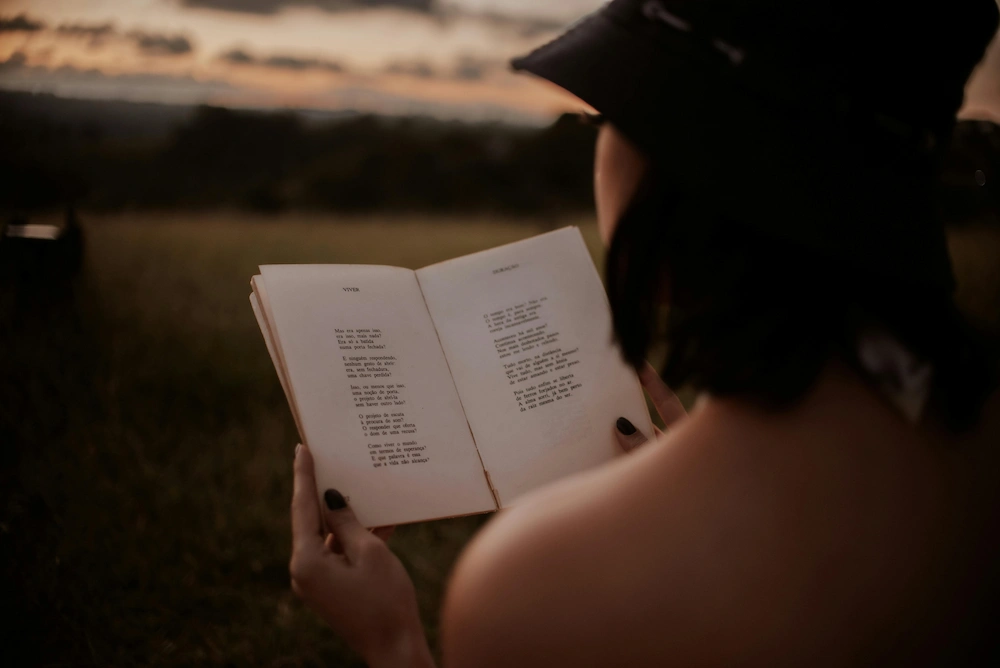
10. Accent by Rupi Kaur
Kaur’s “Accent” is modern, direct, and sharp. It nails identity and confidence through lean lines.
Among contemporary free verse examples in poetry, this one proves that brevity can intensify impact rather than dilute it.
- Packs big meaning into small form. Each word is chosen to connect, not impress.
- Redefines what’s personal (voice, accent) as strength, not flaw.
- Invites a wide audience by being clear and accessible.
Try This
The power comes from line breaks that isolate key phrases, forcing the reader to pause and absorb identity as statement.
Write about a trait you hid but now claim. Six to twelve lines, all clear and without fluff.
If you’re building a public-facing voice or manifesto, this stripped-down style works.
Best for sharing social poems, building connection, and tackling identity head-on.
11. Harlem by Langston Hughes
“Harlem” works like a fuse. Each question raises tension and urgency around deferred dreams.
This is one of the most studied free verse examples in poetry because escalation replaces rhyme as the engine of momentum.
Craft Breakdown:
- Craft a list of escalating “what if” questions about a single frustration.
- Use brief, sensory images that move from small damage to big risk (“raisin,” “explosion”).
- Finish with a sharp turn that leaves no doubt about the stakes.
Try This
The final line detonates everything that came before it, proving that compression can carry explosive force.
This structure pushes your reader to act or reflect. Write with the goal of leaving an echo in their mind.
This poem shows you how compression and escalation make free verse undeniable.
Ideal for poems about risk and waiting, or whenever you need impact in limited space.
12. After the Sea-Ship by Walt Whitman
“After the Sea-Ship” is movement turned to music. Whitman choreographs energy with repeated openings and alliteration.
Here, repetition becomes propulsion, showing how free verse examples in poetry can generate rhythm through syntax instead of strict meter.
Craft Breakdown
- Each line pushes the action; nothing is static.
- Uses catalogues, sound, and rhythm to mimic waves and crowds.
- Gives you a playbook for writing movement, montage, or group scenes.
The poem builds momentum by stacking motion verbs, creating cinematic pacing long before film editing existed.
Try This
Set a place in motion using repeated sentence starters. Keep the stanza rolling without breaking the journey.
Great for film, multimedia, or anyone writing scenes that need pace and collective energy.
13. Splishy, Sploshy Mud by Ava F. Kent
Everyone benefits from play, and this poem brings free verse to kids with maximum fun.
Even playful free verse examples in poetry rely on deliberate sound design and controlled repetition.
Craft Breakdown
- Onomatopoeia and repetition deliver energy. The pace matches splashy feet.
- Makes a mess, but each line is intentional. Every sound builds delight.
- Turns ordinary experience into an invitation for imagination and movement.
The structure mirrors the action, proving that sound can substitute for rhyme when shaping young readers’ engagement.
Try This
Write a short, sound-driven poem for kids. Use repeated action words and clear, active images.
When you want to energize, engage, or get kids playing with words, start here.
Perfect for parents, teachers, and children’s creators aiming for joy and engagement.
14. Follow the Moon by Marie Tully
Tully’s poem brings bedtime calm with gentle refrains and big emotions.
Among softer free verse examples in poetry, this one demonstrates how repetition creates emotional security rather than tension.
Craft Breakdown
- Uses simple questions to create participation and comfort.
- The narrative arcs from curiosity to companionship.
- Celestial images make big feelings feel safe and close to home.
The repeated questioning pattern forms a subtle arc, guiding readers from curiosity to reassurance without overt explanation.
Try This
Write a bedtime poem with repeated questions and a strong, soothing motif (moon, star, cloud).
This approach is effective for calming content, guided reflection, or illustrated books.
Best for soothing nighttime routines, gentle reflection, and introducing emotional language to children.
How to Read and Write Free Verse With Confidence
After studying these free verse examples in poetry, the next step is applying practical strategies that get results fast. Skip the rules that hold you back and focus on a workflow that delivers.
Craft Breakdown
- Read aloud. Break your lines where your breath pauses.
- Use repetition, question chains, or catalogues for structure. - Keep the first six lines concrete: objects before feelings.
- Build two versions—one minimal, one expansive—before you choose what fits.
With WriteSeen, you can upload, timestamp, and share drafts in private or get peer feedback on work-in-progress. Store your creative journey and control what goes live. Use our tools to test what resonates before release.
Free verse is freedom you can shape, structure, and share—without giving up ownership.
Quick Checklist: From Inspiration to Opportunity
Use this checklist to turn what you’ve learned from the poems above into real output. Pick one approach, draft fast, edit with intent, then share for feedback while your work is still moving. The goal is simple: convert inspiration into a stronger poem, a clearer process, and a trackable creative record you can build on.
- Choose a poem model with the tone and form you want.
- Anchor early lines in details, not abstractions.
- Edit fast cuts: swap vague for vivid, trim any line that isn’t conversational.
- Share with a creator’s note to guide feedback.
- Log changes and timestamp every draft.
- Tag with genre and audience for discoverability.
Stay consistent with version control and peer review to meet industry standards and protect your voice. On WriteSeen, set portfolio pieces to public only when you’re ready, keeping feedback lines open for iteration along the way.
Conclusion: Free Verse Examples in Poetry
Free verse isn’t the absence of structure—it’s the deliberate shaping of thought, rhythm, and image on your own terms. The fourteen poems above prove that momentum can replace rhyme, sequence can replace meter, and repetition can generate emotional force without traditional constraints. When you understand how these writers build movement, tension, intimacy, and clarity, you gain control over form rather than feeling restricted by it.
The real value of studying free verse examples in poetry is seeing how freedom still demands intention. Line breaks, breath, imagery, and voice are choices, not accidents. Whether you lean toward minimalism, escalation, sensory layering, or bold catalogues, the goal is the same: make every line earn its place and let structure emerge from purpose.
When you’re ready to draft, refine, and protect your work, join WriteSeen. Upload your poems, timestamp every version, gather focused feedback, and build a portfolio that grows with your craft. Turn experimentation into progress—and move from inspiration to visibility with a community built for serious creators.
TAGS